Interesting Facts About Istanbul


Quick Links:
Istanbul Travel Guide
Istanbul Hotels
Airport Transfers
Istanbul Map
Istanbul Tours
Boat Tours
Istanbul Restaurants
 Istanbul Travel Information
Istanbul History
Istanbul Travel Tips
Inside the city: Istanbul Transportation
Istanbul Travel Information
Istanbul History
Istanbul Travel Tips
Inside the city: Istanbul Transportation

A classic Istanbul ferry boat — the heart of the city
The ferry boat you see in the picture above and simit, a Turkish specialty food, oven cooked dough with sesame seeds, along with tea is the ultimate Istanbul to Turkish people.
Istanbul is dubbed by Turkish poets and Turkish people alike, the City of Seven Hills, like Rome. Interestingly Istanbul was the capital of the Roman Empire after Rome. The city offers gorgeous views from not only from these hills but also from seaside locations.
Looking at modern Uskudar, it is hard to imagine the battle to unite Roman Empire was done in Uskudar and upon victory Roman Emperor Constantine moved the capital of the Roman Empire from Rome to Istanbul.
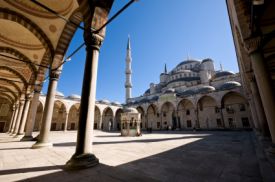
Sultan Ahmet was a big failure as the Sultan of the Ottoman Empire yet his name is way more popular than other great sultans such as Fatih Sultan Mehmet who conquered Istanbul or Suleyman the Magnificent who expanded the territories of the empire to its peak. The reason is Sultan Ahmet had ordered the building of Sultanahmet Mosque which rivaled St. Sophia and gave its name to the neighborhood. So once more a person of power and wealth has made his name eternal through patronage of arts. You never know how you will be remembered so it helps to support art!
Tulips, symbol of Netherlands, patsy of the Tulip Bubble, originated in Istanbul and was sent from Istanbul to Netherlands.
Our grandfathers and grandmothers living on the Asian side of Istanbul used to say 'I am going to Istanbul today' before leaving home for an hour trip to the European side of Istanbul marking the contrast between the two sides of the city. They did go to the European side mostly for compulsory reasons like, a hospital visit, business or shopping and after returning home would say things like my head is spinning.
Tea is a fairly recent national drink. It was Turkish coffee which was the national addiction but after coffee became expensive and it was possible to plant tea leaves in the Black Sea region, tea became the national drink. Turkey does not have production of coffee as it does not have a favorable climate for coffee production.
Some remains of the Great Palace of Byzantine are under Sultanahmet. In fact there are some small tunnels closed to public access but were filmed in documentaries. Remains from the Palace are mosaics in Mosaic Museum.
Needless to say the most important historical figure who has lived in Istanbul is Mustafa Kemal Ataturk who has passed away in Dolmabahce Palace, a summer residence of the president at the time. Among other famous people who have spent time in Turkey or Ottoman Empire are Kaiser Wilhelm, Franz Liszt, Florence Nightingale, Gustave Flaubert, Agatha Christie and Pierre Loti.
Although the major Mevlevihane (whirling dervish home) is in Konya, there is one in Galata as well. Every other week, on second and fourth Fridays of every month there is a sema show (whirling dervish show).
April 23rd is a very special day in Turkish life. It is the children's national holiday, the only national holiday in the world dedicated to the children. But there is another celebration in Buyukada the largest of the Prince's islands: Turkish people visit Aya Yorgi church, a Byzantine Greek Orthodox church to make wishes. This was surprising even for the father of the church at the beginning as Muslim Turkish crowds would come to the church to make wishes so that they come true. Muslim scholars on that day would distribute free Qurans to inform Muslims to give up this superstition. Still, Turkish people would keep going there every year as they see it as a nonreligious activity in a church, simply a ritual to bring good luck. This was so interesting for Greek people who come to visit the church on the 28th of April that finally, a documentary movie was made about it in 2009: Bells, Threads & Miracles.
Bosphorus is where ordinary people go there fishing for food next to multimillion dollar seaside villas known as yalis.
Nisantasi is a small time Soho, in case you want to try posh shops in Istanbul with streets decorated with fancy cobblestones and lamp posts. That's the part of city center for high income people.
Turkish society have become a class society after 30 years of neoliberal economic policies. You have the bankers, people working or doing business with multinational corporations, people tied to the state and to the governing party "du jour". And all of them tied to Wall Street. Lots of debts and lots of glamour is built since 2001. If you see in guidebooks or internet sites phrases such as "Istanbul has become hip", "In", that's why. Istanbul has always been beautiful, it is not a recent happening!
Insider Tip: The whirling dervish show at Galata Mevlevihanesi is authentic and less touristy than the shows in Sultanahmet. Check the schedule in advance — shows are only on certain Fridays. The Aya Yorgi church on Buyukada is a fascinating cultural experience; visit on April 23rd to see the unique tradition described above.
More Istanbul Resources:
Istanbul Travel Guide
Istanbul History
Istanbul Travel Tips
Istanbul Transportation
Istanbul Restaurants
Istanbul Boat Tours