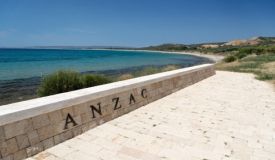
Gallipoli is beautiful and it is sad. That is the contradiction you carry with you. The peninsula is Aegean blue, olive green, wildflower yellow — the kind of place you would pick for a summer house. But the ground is full of boys. British boys, French boys, Australian boys, New Zealand boys, Turkish boys. They came in 1915 and most of them never left. The landscape does not let you forget. The trenches are still there, carved into the hills. The cemeteries sit on ridges with views that would make you weep even without the headstones. It is not a battlefield in the abstract. It is a place where you can stand at the exact spot where a 22-year-old from Perth or Wellington or Istanbul stopped breathing. That specificity is what makes it different from other war memorials.
Situated at around 315 km from Istanbul and 15 km from Canakkale, Gallipoli is a beautiful peninsula blessed with Aegean blue crystal waters kissing sandy beaches, olive trees, flower-covered hills and timeless small fishing or farming villages. For some, one important fact once overshadowed all this serene beauty: the strategic importance of Dardanelles. That is why this place witnessed one of the bloodiest battles of WW1.
In 1915, an allied campaign aiming to pass the Dardanelles has started. The mission was straightforward: reaching Istanbul and gaining the control of the Dardanelles and Bosphorus straits so that Russians would get the much needed support to put a bigger pressure on the Central Powers that included Germany, Austrian-Hungarian Empire and Ottoman Empire.
When British Royal Navy and French Marine Nationale failed the mission losing five ships against Turks while trying to pass through the strait, a decision has been taken which would have a huge impact on many young soldiers from both sides: the battle was to be continued on the ground and various ground troops including the British, French, and a special force which was recently formed: Australian and New Zealand Army Corps also known as ANZACS, eventually hit the shores. 44,000 of these allied soldiers never made it home and around 100,000 of them were wounded. The Anzacs had to leave 11,500 of their comrades in Turkish soil. The Turkish losses were horrendous: 87,000 dead and 165,000 wounded.

The Anzacs came ashore on the morning of April 25, 1915 and fought in the region until January 9, 1916. The cove that they first stepped on the Gallipoli soil is called the Anzac cove (Anzac Koyu) and each year on the same day (Anzac day) a commemoration service is held starting from this point at dawn where Ari Burnu Monument and Cemetery lie. The other important battle fields, monuments and cemeteries are Burnt Hill (Yusufcuktepe), Chunuk Bair (Conkbayiri), Lonepine (Kanli Sirt), The Nek, The Turkish Memorial, Museum and Cemetery (Sehitler Abidesi, Turk Sehitligi ve Muzesi). The area which is a national park now contains total of 31 war cemeteries.
The aftermath of the campaign is interesting. After a bloodbath which took around a total of 131,000 lives and left 261,000 wounded from both sides, Allies could not pass the Dardanelles. Russia never got the support on time and as a result of this failure, a communist revolution swept away the Great Russian Empire. Although some objections appear from time to time, it is believed that this campaign led to a beginning of national consciousness and identity in Australia and New Zealand. Every Anzac day, more and more Australians and New Zealanders take their place in Dawn Commemoration in Anzac cove, remembering their losses and keeping their flags up and high for their fallen boys who took tremendous amount of pain with honor and pride.
For the Turks, the losses were unbearable, except for the fact that a promising, charismatic young officer called Mustafa Kemal Ataturk who would establish the Turkish Republic 8 years after this campaign, showed his talents here as a commander and built up a reputation among the Turks as a leader to be followed till the end.
Despite the beauty surrounding the region, Gallipoli is a sad place. It has a special meaning in the daily life of Turks reflecting a mix of pride, honor, pain and suffering. It echoes in some old Turkish folk songs or it is embedded into idioms like "No passage through Canakkale" indicating a well built defensive position against a much more powerful offensive move.

The centenary commemorations of 2015 brought enormous infrastructure investment — new roads, a larger museum, better signage. That infrastructure remains, but the crowds have thinned. Anzac Day still fills the cove, but on an ordinary Tuesday in May you might share Chunuk Bair with three other visitors.
The Gallipoli Historical Site museum near the Martyrs Memorial was renovated in 2022 and is now genuinely excellent. It presents both Allied and Turkish perspectives with artifacts, maps, and personal letters. Allow 90 minutes.
Drone photography is banned across the national park. This is enforced. Do not bring one.
The ferry from Canakkale to the peninsula runs more frequently now, but most visitors still arrive by car or tour bus. The road from Istanbul is highway almost all the way.
Spring (April to May) and autumn (September to October) are ideal. The peninsula is green, the wildflowers are out, and the heat is manageable. April is dominated by Anzac Day preparations; if you are not attending the service, avoid the week around April 25.
Summer (June to August) is hot and dry, with temperatures above 30°C. The battlefields have almost no shade; walking them at midday is punishing. Start early.
Winter is cold, windy, and empty. Some smaller cemeteries feel inaccessible after heavy rain. But the solitude is profound. If you want to hear the wind instead of tour guides, come in January.
Gallipoli can be reached either from Istanbul or Canakkale and daily tours are always available from these cities.
From Istanbul, the drive is roughly five hours by car or organized tour. The route crosses the Dardanelles by ferry at Eceabat or by the 1915 Canakkale Bridge, one of the world's longest suspension bridges. The bridge saves time but the ferry gives you the view the soldiers would have had, the strait, the cliffs, the sense of why this place mattered.
Buses from Istanbul to Canakkale take six to seven hours. From Canakkale, local buses or taxis reach the peninsula in twenty minutes. Ferries from Istanbul to Canakkale operate seasonally but are slower than the road.
Most visitors book a guided day tour from Istanbul that includes transport and a battlefield guide. A good guide is essential, the landscape looks peaceful now, and without explanation the tactical significance of each ridge and gully is invisible.
The Gallipoli peninsula is not large, but the sites are spread across it and the terrain is hilly. You cannot walk the whole circuit in a day.
The standard route runs from north to south: Anzac Cove and Ari Burnu, Beach Cemetery, Shrapnel Valley, Plugge's Plateau, Quinn's Post, Steele's Post, Chunuk Bair, Hill 971, The Nek, Lone Pine, Johnston's Jolly, Walker's Ridge, then across to the Turkish side: the 57th Regiment Memorial, the Canakkale Martyrs Memorial, and the museum.
A car gives you flexibility but a guide gives you context. If you drive yourself, buy the detailed battlefield map sold at the museum. The official signage is improving but still misses nuances, like why Chunuk Bair was the decisive high point.
There is no public transport between the northern and southern battlefield zones. Taxis from Canakkale can be hired for a half-day circuit, negotiate the price upfront.
Gallipoli is safe. The risks are sun exposure, dehydration, and twisted ankles on the steep, loose paths. There are no fences at most cliff-edge cemeteries; watch your step.
Drinking water is available at the major memorials but not at every cemetery. Carry a bottle.
Photography is permitted everywhere except inside the museum's special exhibition rooms. Be respectful at cemeteries, loud conversation and selfie poses on headstones are offensive and common enough that Turkish staff will intervene.
The Canakkale Martyrs Memorial has a strict security checkpoint. Bags are scanned. The wait is usually short but can be longer on Turkish national holidays.
Day 1 — The Anzac Sector: Start at Anzac Cove before the tour buses arrive. Walk the beach, read the inscriptions at Ari Burnu, then climb the steep track to Plugge's Plateau for the view the Anzacs saw on the first morning. Continue to Shrapnel Valley Cemetery, Quinn's Post, and Steele's Post. Lunch at a cafe in Kabatepe. Afternoon at Lone Pine, the Australian memorial, and The Nek, the narrow ridge that cost so many light horsemen. End at Chunuk Bair for sunset and the New Zealand memorial. Overnight in Canakkale.
Day 2 — The Turkish Sector & Southern Sites: Morning at the Canakkale Martyrs Memorial and the renovated museum. Afternoon at the 57th Regiment Memorial, then the French cemetery at Morto Bay. If time permits, visit the British Helles Memorial at the tip of the peninsula. Return to Canakkale for dinner by the water.
Is Gallipoli worth visiting if I am not Australian or New Zealander?
Yes. The landscape is beautiful, the history is genuinely moving regardless of nationality, and the site explains a pivotal moment in 20th-century history. Turkish visitors come in large numbers, and travelers from Britain, France, Canada, and elsewhere find it equally meaningful. You do not need a personal connection to be affected by it.
How many days do I need for Gallipoli?
One full day is sufficient for the main battlefields, Anzac Cove, and the major cemeteries if you are on a focused tour. Two days allows a slower pace, time for the Canakkale museum, and a visit to Troy. Most visitors combine Gallipoli with an overnight in Canakkale.
Can I visit Gallipoli on Anzac Day?
Yes, but it requires planning. The Dawn Service at Anzac Cove on April 25 requires a ballot registration months in advance due to limited space. The atmosphere is powerful but the crowds are enormous. If you want to experience the site in quiet, visit on any other day.
How do I get to Gallipoli from Istanbul?
The drive is roughly five hours by car or organized tour. Buses from Istanbul to Canakkale take six to seven hours; from Canakkale, local buses or taxis reach the peninsula in twenty minutes. Ferries from Istanbul to Canakkale also operate seasonally. Most visitors book a guided day tour from Istanbul that includes transport and a battlefield guide.
What should I wear at Gallipoli?
Comfortable walking shoes are essential, the terrain is steep, rocky, and uneven. Layers are useful; the peninsula is windy and can be cold at dawn even in spring. For Anzac Day, warm clothing is necessary as the service begins before sunrise. Sunscreen and a hat are recommended for summer visits.
Are there Turkish memorials at Gallipoli too?
Yes, and they are central to the site. The Canakkale Martyrs Memorial dominates the southern end of the peninsula and is visible from most points. There are also Turkish cemeteries, the 57th Regiment Memorial, and the Gallipoli Historical Site museum. The Turkish perspective is presented with equal weight alongside the Allied memorials.