
Temple of Trajan, Pergamon
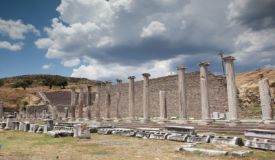
Asclepion, Pergamon
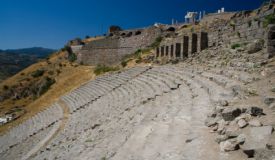
Theater, Pergamon
Situated at the outskirts of the modern day Turkish city Bergama, Pergamon was one of the principal centers of Hellenistic civilisation in the region although the settlement here goes back to as early as 12th century BC. Ruled by Persians in 6th century BC, the city was inevitably conquered by Alexander the Great in 334 BC.
Eumenis II, grand children of a nephew of a Pergamon commander who had taken control of the city along with a considerable treasure from the Macedonians after Alexander the Great's death, finally managed to build the Pergamon Kingdom in 2nd century BC. With this power and wealth the golden era of Pergamon had started. The kingdom became a part of the Roman Empire in 129 BC.
Pergamon is a beautiful ancient treasure literally filled with buildings and temples but it is also a city of innovation. The first psychotherapy treatment center, Asclepion, was built here. Also the parchment (or Pergamene paper that was made of treated animal skin) was invented in Pergamon due to a necessity caused by the lack of papyrus importation from Alexandria. Papyrus was a very important material for Pergamon as its library was competing against the biggest library of the same era, the library of Alexandria.
Pergamon is also famous for its role in the early days of Christianity and it is mentioned as one of the Seven Churches of Revelation.
"Shouldn't miss" list is rather long but is definitely worth visiting:
The Pergamon Acropolis situated at the top of a hill.
The Theater, with a capacity of 10,000 spectators, again built against a hill like most of the other theaters in Western Anatolia.
Asclepion, a stunning example of an ancient times medical center. It was in fact established by Archias who had also practised medicine at Asclepion of Epidaurus in Greece. But the name really boosted the fame of Asclepion of Pergamon in 2nd century AD is Galen, a former Gladiator healer, personal MD of the Roman Emperor. He was a Pergamon born physician (considered as the first one in the modern medical history), educated in Alexandria. He was the one who excelled the practices of massage, mud baths, use of herbal curing methods and dream analyzing in Asclepion. His teachings at the medical school of Pergamon featured the signs of the first systematic medical theory, medical research, and of course application.
The Pergamon Library which once hosted more than 200,000 units of transcriptions. Oddly, they were then given to Cleopatra as a gift from Marcus Antonius, the famous Roman Emperor. These books have indeed ended up in the Library of Alexandria which once was the biggest rival of the Pergamon Library. Unfortunately, they are believed to be destroyed during a revolt there.
Red Courtyard or Red Basilica, a building made of red bricks which dates back to 2nd century AD. Originally dedicated to the Egyptian god Serapis, then converted to a Basilica by the Byzantians.
The Temples of Zeus and Dionysos.
Trajan and Athena temples.
There is also a small Archaeology Museum and a Museum of Ethnography in Pergamon which are worth visiting to see some statues and art work transferred from the ruins.
The Acropolis is on a steep hill. You can walk up (about 20-30 minutes uphill) or take the cable car (teleferik) from the town of Bergama. The cable car saves time and energy, especially in summer. The path from the upper cable car station to the Acropolis is still uphill but manageable. Comfortable walking shoes are essential — the theater is very steep and the marble streets can be slippery.
The original Pergamon Altar is no longer at the site. It was taken to Berlin in the late 19th century and is now displayed at the Pergamon Museum in Berlin. At the original site, you can see the foundation and a replica of the altar. The terrace still gives you a sense of its scale and the view is spectacular.
The Asclepion is located on a separate hill, about 2 km from the Acropolis. Allow 1 hour to visit the Asclepion complex — the sacred spring, the treatment rooms, and the small theater. The site is less crowded than the Acropolis.
To know where Pergamon sits in the timeline of Anatolia's (Modern Turkey) ancient history please see History of Anatolia
Pergamon is located 103 km north of Izmir, about a 1.5-hour drive. From Izmir, you can take a bus or train to Bergama, then a short taxi or minibus to the cable car station. From Istanbul, the drive is about 7 hours — most visitors fly to Izmir first. Many visitors combine Pergamon with Ephesus on a 2-3 day tour from Izmir or Kusadasi.
If you are arriving by cruise ship at Kusadasi or Izmir, Pergamon is a longer day trip (about 2-3 hours each way from Kusadasi). A private tour is recommended.
To get to Pergamon you can use bus and local minibus services or use a private Izmir Airport Transfer
Morning (9:00 AM - 12:30 PM): Take the cable car from Bergama town to the Acropolis. Visit the theater, Temple of Trajan, the library ruins, and the foundation of the Altar of Zeus. The view over the valley and the modern town below is worth the trip alone.
Lunch (12:30 PM - 1:30 PM): Lunch in Bergama town. There are small family-run restaurants near the cable car station and the Red Basilica.
Afternoon (1:30 PM - 4:00 PM): Visit the Asclepion (medical center). The sacred spring, the treatment rooms, and the small theater are the highlights. Then visit the Red Basilica (Red Courtyard) in the town center. If time permits, stop at the Bergama Archaeological Museum before leaving.
Tours from Istanbul and Izmir are available.